Density
| density | a measure of how tightly packed particles are in an object |
| mass | a measure of the amount of matter in an object |
| volume | a measure of the amount of space an object takes up |
Density Formula

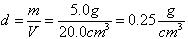
Mass divided by volume
Mass # always goes into the calculator first even if it’s smaller
EX: If mass is 5.0 g and volume is 20.0 cm3 then d = 0.25 g/cm3
Three Important Density Facts
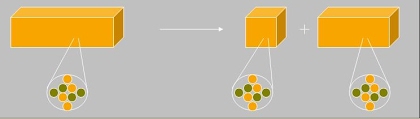
- Density does not change if you cut an object into pieces.
- If you have a block with a density of 0.25 g/cm3 and you cut the block in half, its density will still be 0.25 g/cm3.
- Same material, so it’s the same density!
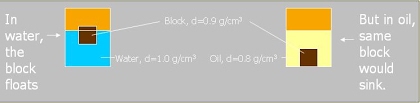
- Density can help predict whether an object will float in a liquid.
- If the object has a lower density then it will float.
- EX: A block that has a density of 0.9 g/cm3 will float in water (d = 1.0 g/cm3) but will not float in oil (d = 0.8 g/cm3).
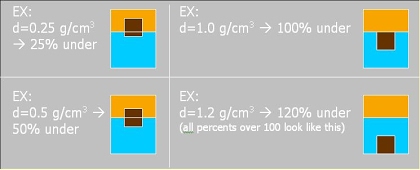
- Density values can predict where an object can float in water.
- Just view the density as the % underwater.
- Mentally multiply density by 100.
- Anything over 100% then it is at the bottom.
How is Volume Calculated?
Rectangular solid (ex: block of wood): volume = length x width x height
How is Density Calculated?
| g/cm3 | = | g |
| cm3 |
Will It Float in These Liquids?
An object will float in a liquid if its density is less than (or equal to) the liquid's density. If the object has a greater density, then it will sink.
Auto:
Water has a density of 1.00 g/mL. To determine how high or how low an object will float in water, simply multiply the object's density by 100. That will tell you what percent of the object is in the water. The rest will be above the water line. Any percent greater than 100, then the object will sink to the bottom.