Significant Figures
Use of significant figures ensures that values are reported accurately based on how precise the measured values are.
Accuracy vs. Precision
|
 |
Significant Figures
- A calculation cannot be more precise than the least precise measurement used to find the answer
- Let’s say you counted the leaves on three trees.
- One tree had 4,115 leaves.
- The second tree had 4,986 leaves.
- When you counted the third tree, you got bored and estimated 3,000 leaves.
- If you calculate the average, it isn’t going to be very precise because one value (3,000) was not precise.
- You wouldn’t report the average as 4033.6666667. It wouldn’t make sense to be so precise when one measurement wasn’t precise.
- You would have to report the average as 4,000 leaves.
- Significant figures help us to keep our answers appropriately precise for all measurements and calculations
Significant Figure Rules
- All digits 1 through 9 are significant
- 54.238 → has five significant figures
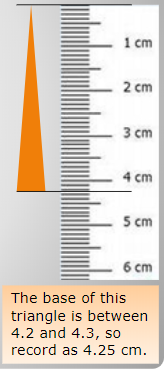
- Measured values including the one estimated value (such as the hundredths place on a meter stick) are significant
- Zeroes are significant if they are not just place holders
- Zeroes in between any two significant numbers ARE significant
- 904 → has three significant figures
- Zeroes in front of non-zero digits are NOT significant
- 0.0854 → has only three significant figures
- Zeroes that are at the END of a number AND AFTER a decimal ARE significant
- 52.00 → has four sig. figs. 234.50 → has five sig. figs.
- Zeroes that are at the END of a number AND BEFORE a decimal are ONLY significant if they are the first estimated digit (i.e.: from a meter stick) or if they have been measured.
- From a meter stick (thus, measured): 70. cm → has two sig. figs.
- 3,000 → has only one sig. fig.
- Zeroes in between any two significant numbers ARE significant
Operations With Significant Figures
Addition and subtraction have different rules than multiplication and division
Addition and Subtraction
- Keep the same number of decimal places as the least precise value being added
- 23.6 + 3.59 → 27.19
- “23.6” has ONE decimal place, while “3.59” has two decimal places
- 27.19 must therefore be rounded to 27.2 which also has only ONE decimal place
Multiplication and Division
- The final answer must have the same number of significant figures as the least precise value being factored in
- 12.78 * 0.042 = 0.53676
- “12.78” has 4 sig figs, but “0.042” only has 2 sig figs
- 0.53676 must be rounded to 2 sig figs → 0.54